By Kate Martin, Lucy Barnes & Irene Ramos
(Knowledge Equity & Open Scholarship Week 2026 – Co-creation Experiment Group)
On 28 April, three people from three different countries who hadn’t met each other before joined a call to begin talking about our experiences of open research and publishing. We began by going into our backgrounds – community-led open access book publishing, open data and community management, and academic librarianship respectively – before trying to find ways to start talking about our perspectives on a short call in a structured way.
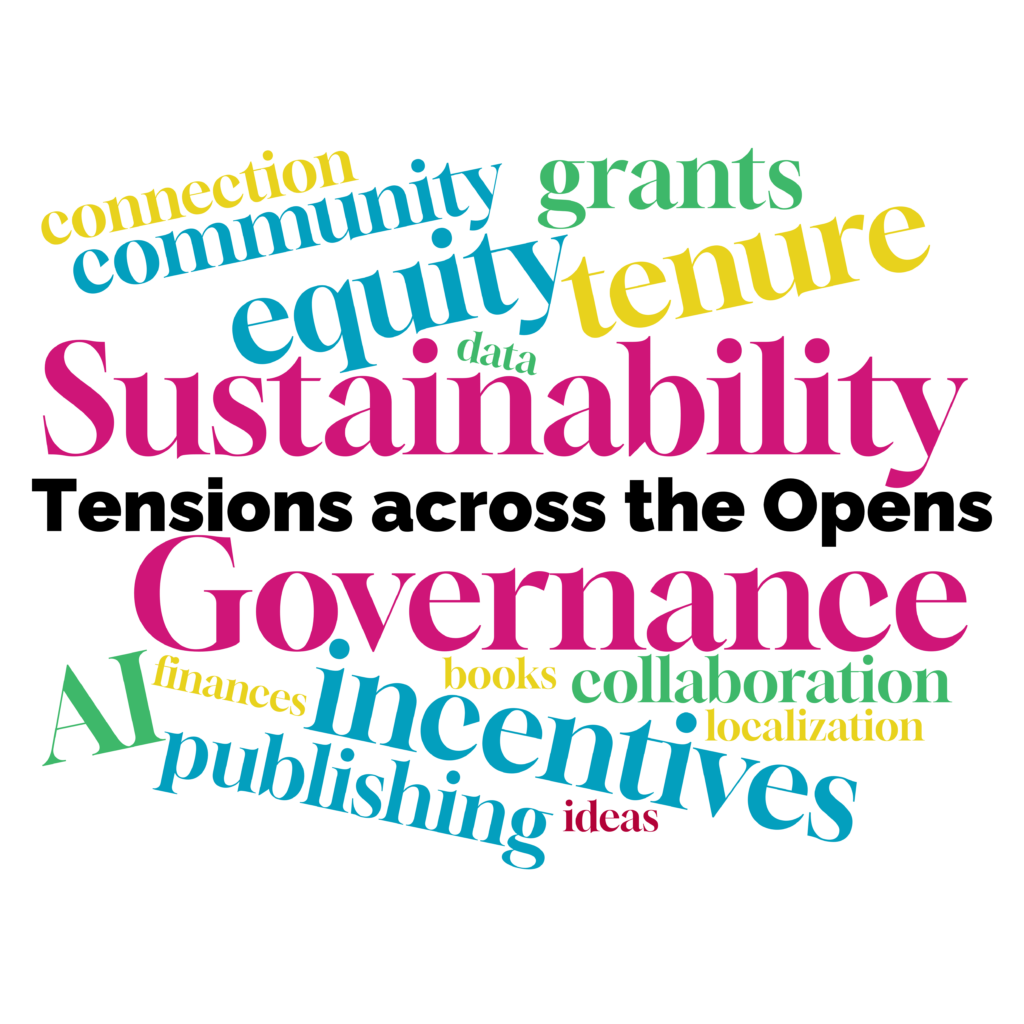
Our co-creation exercise began by each writing five words that we associate with our open practice, and then discussing them. We quickly found that across our different contexts – be those contexts geographical, organisational, or related to our roles – there were some core areas in which we are facing shared challenges. In this post, we will explore three of those areas: AI, governance, and sustainability. In each area, one of us will describe our own perspective and that of our co-creators, and through this approach, we hope to capture not only the nature of those shared challenges as well as some points of difference, but also to describe the experience of the co-creation experiment itself.
AI: Kate
Artificial Intelligence is a topic that we are both tired of discussing and cannot say enough about. Exasperated sighs often mark the beginning of an AI discussion. Our cohort remarked on the over-exposure of the topic at meetings, in professional developments, industry readings, and all over our personal devices. Everyone seems tired of talking about artificial intelligence, and yet, we can’t stop talking about it. Our group was no different. Representing open publishing in the United Kingdom, open science publishing in Mexico, and academic librarianship in the United States, the tensions of AI weigh on each of us. A deep sense of uncertainty framed our conversation, while themes of protecting discipline specific knowledge, and the quality of AI outputs emerged.
The feeling of incertitude is likely the driver of the endless AI conversations, the impacts of the tools are already uncomfortable for many, and the long-term effects unknown. Participants shared that although many of our colleagues express skepticism and feel that the current tools add little value to daily tasks, there are many pressures from above to use AI tools. With little guidance or security measures, this does not always feel aligned with the larger institutional values we work under. From the publishing perspective, submissions with heavy AI usage were clearly a lower writing standard, the writing showing patterns indicative of the predictive nature of Large Language Models. Submissions made with AI may have saved the author some time in writing, but the back-end work that was needed to ensure the submission is up to the journal’s standard takes far more time than authored pieces.
Similarly, in Open Science, Irene shared that the level of oversight needed to be able to accurately use the AI tools requires a high level of knowledge in the field you are prompting about. This experience is earned over time, knowledge building that is now becoming more automated by generative AI tools, rather than up incoming professionals. This could create a large skills gap and leave organizations without knowledgeable experts to assess AI outputs. In Kate’s experience as an academic librarian, a very similar conversation is often being had in relation to student’s career readiness and AI. Other concerns bubble up throughout our AI conversations, such as protecting data, intellectual property, and maintaining trust in academic resources, especially in open access resources that were used without attribution, contrary to their licence, to train many of these models. Our conversations about industry impacts, personnel changes, and output quality have led to more questions than solutions.
Many of the tensions we find with artificial intelligence are also true of the open publishing industry; Who will do the work? What is the price for the work and who will pay? Is this output accurate and positively impacting educational goals? Unlike artificial intelligence companies, however, the Open Pedagogy movement makes its motivations well known; reduce inequality and improve the global community by increasing access to knowledge. What then, are the motivations of an artificial intelligence company? Are they in alignment with those of the opening movement? And if not, what are we going to do about it?
Governance: Lucy
We found a lot of common ground when discussing governance: in particular the idea that governance can either inhibit open work, or strongly support it, depending on the context in which you’re working and the care with which governance structures are created. As Irene noted, there is a big difference between top-down governance and bottom-up, community-led governance, and being embedded within a larger organisation can inhibit one’s freedom to experiment and innovate with open practices. As Kate pointed out, open access often necessitates pushing against traditional ways of working, and so one might argue that there will necessarily be friction between pre-existing governance structures and open practices: the question is whether those pre-existing structures can flex and adapt to accommodate new open approaches, or whether they remain rigid and stifle experimentation.
Lucy reflected that governance is also critical to the continuing evolution of new models of open access publishing. She noted that in Europe at least, there is a strong argument that diamond open access must be community-led – but ‘community-led’ is often envisaged in reality as ‘institution-led’, because the ‘community’ in question is often characterised as university-based, and therefore implicitly it is governed by institutional structures. However, this ignores thriving independent community-led presses and infrastructures, such as those that make up the Copim community. Copim has conducted a significant amount of research on community-led governance and developed models to ensure collective stewardship of newly built infrastructure such as the governance model of the Open Book Collective.
We all agreed that viewing open access as simply a product, a label or an end-state for published research is short-sighted at best and actively damaging at worst. Open research and publishing are dynamic and evolving processes and they require governance that recognises this and creates space for such evolution.
Sustainability: Irene
Even as we discussed AI and Governance in our communities, our conversation kept coming back to concerns around sustainability: How might we sustain community-led efforts? Why do incentive structures feel at odds with open values?
Kate noted that profit often overshadows conversations about Open Access. This is partly because of persistent assumptions that traditional publishing offers greater visibility, reputation and quality. Pushing against these assumptions can prompt reflection around who bears the hidden costs of scholarly publishing, and the circular problem in which many open initiatives find themselves. For example, OA textbooks could significantly help alleviate challenges of access and affordability in under-resourced institutions, but supporting OER initiatives requires grant funding in the first place. Lucy shared similar experiences in community-led publishing: incentives for tenure and career progression are closely tied to the prestige of venues where researchers choose to publish, so these incentive structures become a barrier to supporting open access routes. As Irene mentioned, these challenges extend to other areas of open science, including software, data, and infrastructure, where many projects rely on short grant funding cycles. Community-led projects require significant infrastructure and resources, and as challenging as these conversations may be, we cannot separate discussions of equity from those of sustainability.
Conclusion
We covered so much in just a short conversation! The Open ecosystem often feels vast, sometimes fragmented. This co-creation experiment gave us the space to ask genuine questions, and to hold together the tensions we face in our day-to-day work as open practitioners. Across geographies and institutional settings, we recognized that governance, sustainability, and disruptive technologies are systemic challenges that require a community-based approach.
Contributors
Kate Martin works as Users Services and Scholarship Librarian, Wilmington University, USA.
Lucy Barnes is a Senior editor and Outreach Coordinator at Open Book Publishers, UK.
Irene Ramos is based in Mexico City, and is a Research Fellow at OLS.
Notes
License: CC-BY